What Is a Qualified Person (QP) in Pharma — and When Do You Need One?
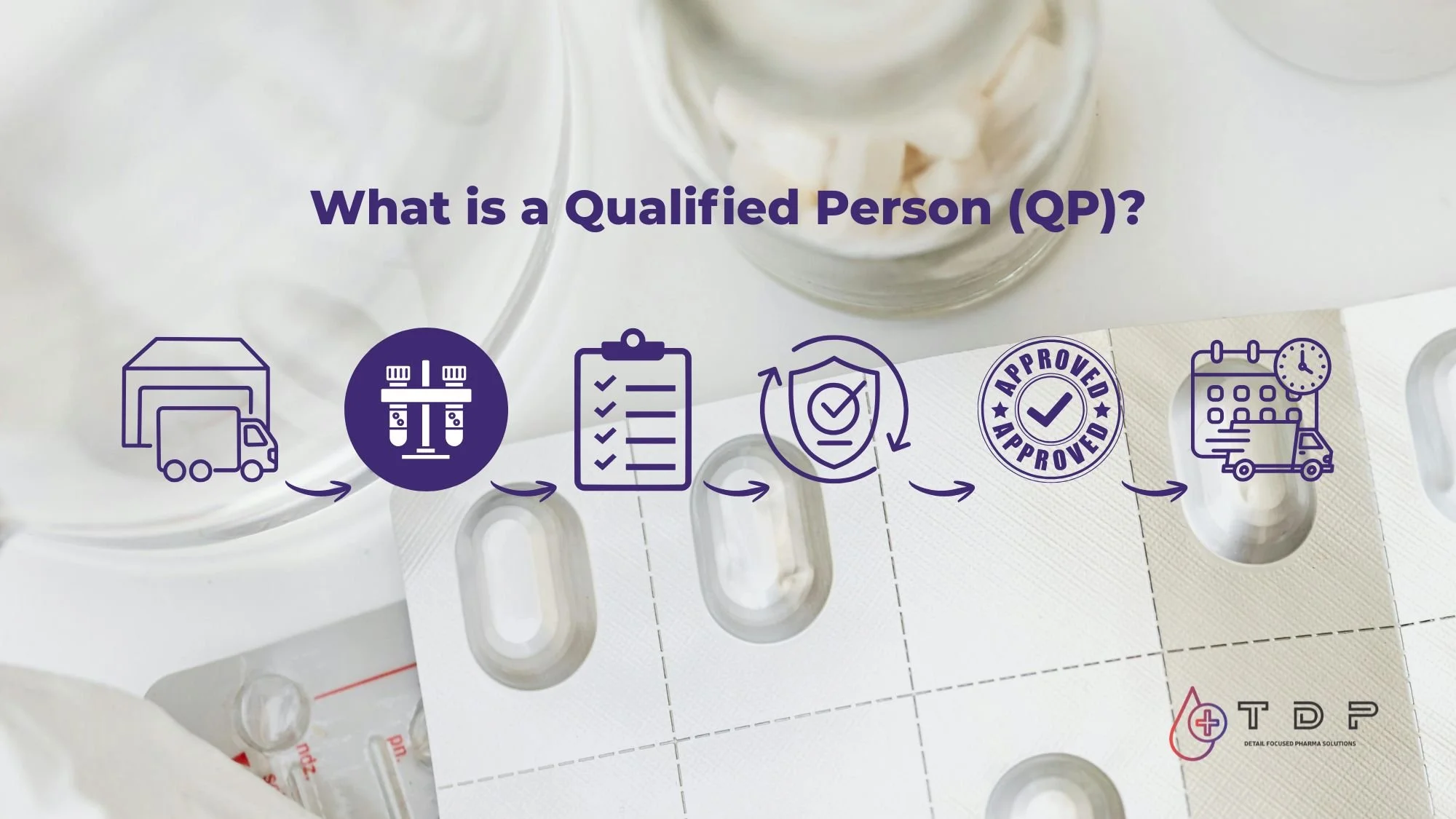
If you manufacture, import, or commercially supply medicinal products in the UK or EU, the Qualified Person (QP) role is not optional — but it is often misunderstood. For many organisations, particularly SMEs and virtual pharma companies, QP responsibilities only become fully visible when preparing for a regulatory inspection, scaling supply, or facing unexpected delays in batch release.
In practice, misunderstanding the QP role can lead to compliance gaps, operational bottlenecks, and unnecessary regulatory risk. This article explains what a Qualified Person does, why the role exists, when a QP is legally required, and how it differs from other regulated roles such as the RP and RPi — with a practical focus on real-world operating models in the UK and EU.
Why the QP role exists
At its core, the Qualified Person role exists to protect patients.
Under EU and UK pharmaceutical legislation, every batch of medicinal product placed on the market must be certified by an independent, named individual. That individual — the QP — must personally confirm that the batch has been manufactured and tested in compliance with both Good Manufacturing Practice (GMP) and the relevant Marketing Authorisation.
This requirement was deliberately designed as a legal safeguard. It ensures that the final decision to release a batch is not driven by commercial timelines, supply pressure, or organisational hierarchy, but by an independent professional judgement grounded in patient safety and regulatory compliance.
Specifically, the QP role ensures that:
Quality decisions are not subordinated to commercial or supply chain pressure
GMP compliance is assessed holistically across manufacturing, testing, and supply
There is clear, traceable accountability for every batch released to the market
Unlike many other quality roles, the QP carries personal legal responsibility. Regulators do not hold “the company” solely accountable — they hold the named QP accountable for their certification decisions. This is what makes the QP role fundamentally different from standard QA sign-off or operational quality functions.
What does a Qualified Person actually do?
Batch certification and release
The central responsibility of a QP is batch certification, as defined in EU GMP Annex 16.
Before certifying a batch, the QP must be satisfied — based on documented evidence — that all regulatory and quality requirements have been met. This includes confirming that:
The medicinal product was manufactured in accordance with GMP
The batch complies fully with the Marketing Authorisation (MA)
All required in-process and finished product testing has been completed and approved
Deviations, non-conformances, changes, and investigations have been properly assessed and closed
The supply chain is controlled and supported by appropriate technical and quality agreements
This assessment is not a checklist exercise. Annex 16 explicitly requires the QP to apply professional judgement, particularly where deviations, atypical events, or complex supply chains are involved.
Only once the QP is satisfied that all requirements have been met can the batch be legally certified and released to the UK or EU market.
Oversight, not execution
A common — and risky — misconception is that the QP “does everything” related to quality. In reality, the QP role is one of oversight and assurance, not operational execution.
The QP:
Does not run the Quality Management System (QMS)
Does not approve every SOP or controlled document
Does not replace QA management or operational leadership
Instead, the QP relies on the organisation’s systems and people to function effectively. This includes:
A robust, well-maintained QMS
Competent QA, manufacturing, and supply chain teams
Clear escalation pathways for quality and compliance issues
Where these systems are immature or fragmented, the QP’s workload — and personal risk — increases significantly. This is why experienced QPs often focus as much on system robustness and governance as they do on individual batch decisions.
When is a QP legally required?
Manufacturing and batch release
You need a QP if your organisation:
Manufactures medicinal products for human use
Performs final batch certification
Releases product to the UK or EU market
This applies regardless of whether manufacturing activities are performed in-house or fully outsourced to one or more Contract Manufacturing Organisations (CMOs). Even in a virtual model, responsibility for batch certification ultimately sits with the Marketing Authorisation Holder and its QP.
Importation into the UK or EU
A QP is also legally required if you import medicinal products from:
Third countries into the EU
Third countries into the UK (post-Brexit)
In these cases, the QP must certify that:
Manufacturing standards applied outside the UK/EU are equivalent to EU/UK GMP
Required testing has been completed in accordance with regulatory expectations or appropriately justified through equivalence or reliance mechanisms
Supply chain oversight, including audits and quality agreements, is robust and current
For many SMEs, importation is the moment when QP requirements become unavoidable — particularly when sourcing products from the US or Asia.
QP vs RP vs RPi — what’s the difference?
These roles are frequently confused, but they are legally distinct and serve different regulatory purposes:
QP (Qualified Person)
Responsible for batch certification of medicinal products under GMP prior to market release.
RP (Responsible Person – GDP)
Responsible for ensuring GDP compliance at wholesale distribution sites.
RPi (Responsible Person for Import)
Responsible for GDP compliance for imported medicinal products in the UK, including oversight of importation and distribution activities.
Depending on your operating model, you may need one, two, or all three roles. Confusing these responsibilities — or assuming one role covers another — is a common inspection finding.
Can a QP certify batches remotely?
Yes — in principle, a QP can certify batches remotely.
Regulators accept remote certification provided that:
The QP has full, secure access to all batch documentation
Data integrity controls are robust and demonstrable
The QP has sufficient knowledge of the manufacturing site, processes, and risks
Supplier oversight, audit status, and change control are effective
However, remote certification does not remove regulatory expectations around engagement and oversight. Inspectors expect QPs to maintain an appropriate level of site familiarity through:
On-site audits
Periodic physical presence
Active involvement in quality governance
“Remote” does not mean “hands-off”, and it does not reduce personal accountability.
Common QP challenges for SMEs and virtual companies
For SMEs and virtual pharma organisations, QP challenges are often systemic rather than technical. Common issues include:
Underdeveloped or rapidly evolving Quality Management Systems
Heavy reliance on multiple CMOs across different regions
Limited internal QA headcount
Cost sensitivity around permanent senior hires
Inspection readiness driven by timelines rather than organisational maturity
In these environments, QPs are often required to operate in stabilisation mode — supporting compliance while helping the organisation mature its systems without disrupting supply or growth plans.
This is also where early engagement with QP support can prevent costly remediation later.
How companies typically resource the QP role
There is no single “correct” way to resource the QP role. Common models include:
A permanent, in-house QP
A contract or interim QP
Shared QP arrangements across multiple products or entities
QP support embedded alongside QA leadership
Each model has different implications for:
Cost structure (operational vs fixed cost)
Regulatory risk exposure
Speed to market and flexibility
Inspection readiness and resilience
The most effective approach aligns QP resourcing with actual operational complexity, rather than simply meeting the minimum regulatory requirement on paper.
Summary and next steps
A Qualified Person is legally responsible for batch certification of medicinal products placed on the UK and EU market. QP certification is mandatory for both manufacturing and importation, and the role is defined by independent oversight and professional judgement — not routine QA administration.
Clear understanding of when a QP is required, how the role differs from RP and RPi responsibilities, and how to resource QP support appropriately can significantly reduce regulatory risk and supply disruption.
If you are unsure whether you need a QP, how the role fits your operating model, or how to structure QP support pragmatically, a short conversation can often provide clarity.